
Solution: Molecular sieve
Jan 30,2026


Z-Type Elevators in Molecular Sieve Industry Conveying Applications—A Dual-Condition Solution for High-Temperature and Ambient-Temperature Operations
Molecular sieves are aluminosilicate materials with a microporous crystalline structure, widely used in the deep drying and adsorption–separation of gas and liquid phases in industries such as petroleum and chemical engineering. Their production involves processes like mixing, granulation, drying, and calcination, which place comprehensive demands on conveying equipment, including high-temperature resistance, low-breakage performance, moisture-proofing, and sealed dust containment. The Z-type bucket elevator, with its high-temperature-resistant design, fully enclosed structure, low-breakage conveying, and multi-point discharge capability, has emerged as the ideal vertical conveying solution for molecular-sieve production lines.
I. Material Characteristics and Conveying Challenges of Molecular Sieves
| Feature | Specific Parameters and Effects |
| **Bulk Density** | Approximately 0.60–0.66 g/mL, classified as a medium-density powder |
| **Wear Rate** | ≤0.20–0.25%, causing some wear on equipment |
| **Crush Resistance** | Molecular sieve particles exhibit high crush resistance; however, excessive impact during handling can still generate fine powder, thereby compromising adsorption performance. |
| **Hygroscopicity** | Molecular sieves exhibit a strong affinity for water, and their adsorption capacity decreases upon moisture uptake.
| **Prone to Breakage** | If molecular sieve particles are subjected to severe impact or compression during transportation, they may fracture and pulverize, leading to a decline in adsorption performance.
Traditional conveying methods for molecular sieves may, due to insufficient conveying capacity and poor operational stability, result in sieve breakage, agglomeration, or uneven mixing, thereby compromising their performance and application effectiveness.
II. Application Solutions for Z-Type Elevators in the Molecular Sieve Industry
1. High-Temperature Transportation Scheme (Molecular Sieve at Over 300°C)
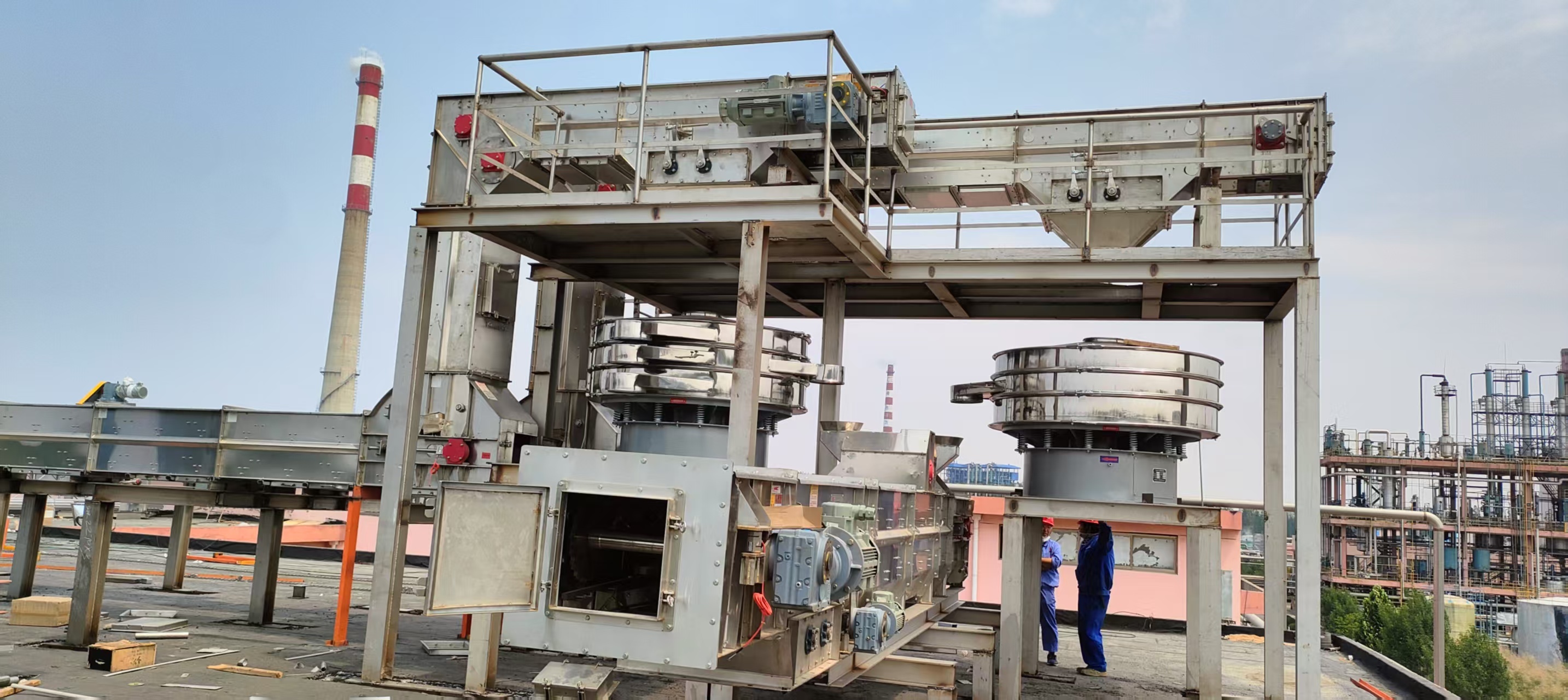
After molecular sieves are calcined in an externally heated rotary kiln, the material temperature can reach above 300°C. The Z-type bucket elevator ensures the safe conveyance of high-temperature materials through the following design features:
(1) Selection of High-Temperature-Resistant Materials**
**Hopper Material**: Select different materials based on the temperature rating—stainless steel is recommended. For temperatures above 300°C, stainless steel must be used to ensure that the hopper maintains its shape and structural integrity under high-temperature conditions. Stainless steel offers excellent resistance to high temperatures, wear, corrosion, and contamination of the conveyed material.
- **Chain**: Made of high-strength, heat-resistant alloy steel with surface hardening treatment, suitable for continuous operation in high-temperature environments.
- **Casing**: Manufactured from high-quality carbon steel to enhance the equipment’s structural strength and rigidity in high-temperature environments.
2. Ambient-Temperature Conveying Scheme (After Drying, Finished Molecular Sieve)
Molecular sieves are conveyed at ambient temperature during drying, sieving, and storage of the finished product; the advantages of the Z-type bucket elevator are as follows:
**(1) Low-damage conveying to protect molecular sieve quality**
- The Z-type bucket elevator employs inflow feeding and smooth operation, ensuring that the buckets remain gravity-fed with the inlet oriented upward at all times when not discharging, thereby minimizing severe impacts and compression among the material particles.
- Field measurements demonstrate that the breakage rate during molecular sieve conveying can be controlled below **1%**, effectively reducing fine powder generation and ensuring both the adsorption performance and particle integrity of the molecular sieve.
- The Z-type elevator features a low material breakage rate, which helps reduce the generation of defective products and is well suited for applications requiring gentle handling of materials.
(2) Fully enclosed and sealed to prevent moisture absorption and contamination**
- The entire machine features a welded, sealed housing with sealing strips installed at all joints, ensuring no dust leakage during the conveying process.
(3) Multi-point discharge, compatible with batching lines**
The Z-type elevator can be equipped with multiple discharge outlets (2–10) on the discharge-level section, with each outlet corresponding to a batching weigh hopper or a packaging machine. Controlled by a PLC, material is fed to the designated discharge outlets as needed, thereby achieving “one piece of equipment, multi-point precise feeding.”
4) Compact structure, saving space**
The Z-type elevator employs a horizontal–vertical–horizontal (Z-shaped) conveying path, integrating the functions of conventional horizontal conveyors and vertical elevators. A single unit can replace multiple standalone systems, reducing floor space requirements by more than 30%, making it particularly well-suited to the compact layout requirements of molecular sieve production facilities.
5) Wear-resistant configuration, suitable for abrasive materials.
Molecular sieves have a certain attrition rate (≤0.20–0.25%) and cause slight abrasion to equipment.
III. Summary of the Core Advantages of Z-Type Elevators
| Advantages | Specific Value to the Molecular Sieve Industry |
|------|------------------------|
| **High-Temperature Conveying** | Capable of reliably conveying molecular sieves at temperatures above 300°C
| **Low Breakage Rate** | Breakage rate controlled below 1%, preserving the integrity of molecular sieve particles and ensuring adsorption performance |
| **Fully Enclosed Dust-Proof Design** | Dust concentration < 1 mg/m³, preventing molecular sieve from absorbing moisture and humidity while improving the workshop environment |
| **Multi-Point Discharge** | One piece of equipment supplies material to multiple workstations, simplifying the layout of the batching and packaging lines |
| **Energy-Efficient Operation** | Variable-frequency speed control reduces energy consumption by more than 30% compared with conventional equipment |
| **Easy Maintenance** | Modular design allows independent replacement of the hopper and chain, ensuring trouble-free operation for ≥20,000 hours |
| **Material Safety** | Stainless steel is corrosion-resistant, easy to clean, and does not contaminate high-value molecular sieves |
IV. Selection Recommendations
For conveying in the molecular sieve industry, the following configuration is recommended for Z-type bucket elevators:
| Configuration Item | Recommended Ambient-Temperature Molecular Sieve | Recommended High-Temperature Molecular Sieve (300°C+) |
|--------|---------------|------------------------|
| Hopper Material | Stainless Steel 304 or 316
| Casing Material | Stainless Steel 304 or Carbon Steel with Coating
| Chain | Standard Alloy Steel Chain | High-Strength Heat-Resistant Alloy Steel Chain |
| Control System | PLC + Variable Frequency Drive, Level-Linked Operation | PLC + Variable Frequency Drive
The Z-type elevator offers a comprehensive solution for both high-temperature and ambient-temperature conveying applications in the molecular sieve industry. For high-temperature molecular sieves above 300°C, its heat-resistant stainless steel construction, forced cooling system, high-temperature sealing, and optional nitrogen purging ensure stable equipment operation and maintain material quality. For ambient-temperature molecular sieves, its low-breakage conveying design, fully enclosed sealing, and multi-point discharge configuration enable efficient, clean, and automated continuous conveying. Whether handling hot calcined clinker or dried finished molecular sieves, the Z-type elevator can be precisely tailored to meet specific requirements, making it the ideal equipment for achieving efficient, environmentally friendly, and reliable conveying on molecular sieve production lines.
Relevant Cases

Why Choose a Non-Crushing Elevator? A Summary of Common Issues with Non-Crushing Elevators
Do you know how to maintain a non-breakage elevator?
Z-type elevator? Let’s learn more!
Specializing in the manufacture of elevators for over 20 years.
Hengshui Changhong Mining Machinery Co., Ltd. has been specializing in the manufacture of hoists for over 20 years, integrating technological development, production and operation, and technical services into one. Drafting author of Changhong Z-type (vertical spiral bucket) elevator enterprise standards, patent-technologied manufacturer, reputable producer of mining machinery with superior quality and strength.
Contact Info
Contact: Manager Pang
Phone:8613932836877,8613315840327
Phone:0086-318-4869777
Fax:0086-318-4868277
Email:384023722@qq.com
Address: Mada Development Zone, Fucheng County, Hengshui City, Hebei Province