
Solution: Iron powder
Jan 30,2026


Analysis of the Z-Type Elevator Conveyor Scheme for Iron Powder
Ultrafine iron powder with a bulk density of 1.5–3 g/cm³ and more than 90% passing a 400-mesh sieve
I. Material Characteristics and Conveying Challenges
| Parameter | Value | Impact on Conveyance |
|------|------|----------------|
| **Medium** | Iron Powder | Magnetic, easily oxidized, high value |
| **Bulk Density** | 1.5–3 g/cm³ | Classified as a **heavy-duty powder** (typical powders range from 0.4–0.8, while iron powder is 3–7 times denser), placing extremely high demands on equipment load capacity, drive power, and hopper strength |
| **Fineness** | >90% passing 400 mesh | Ultrafine powder (particle size <37 μm), with a very large specific surface area, highly prone to dusting, hygroscopicity, and agglomeration/bridging, resulting in poor flowability |
| **Explosion Risk** | Dual Explosion of Dust and Gas | Iron powder is a metallic powder, posing a high explosion risk; additionally, the production environment may contain flammable gases such as NMP.
**Core Challenge**:
1. **Heavy-duty conveying**: With a bulk density as high as 3 g/cm³, the material weighs several times more than conventional powders of the same volume, necessitating reinforced hoppers, chains, and drive systems.
2. **Dust Emission from Ultrafine Powders**: More than 90% of the particles are below 400 mesh, making it extremely difficult to achieve complete containment of such fine dust and placing stringent demands on the sealing performance of equipment.
3. **Bridge Formation and Clogging**: Ultrafine iron powder readily forms “mouse holes” or arching in the feed inlet and hopper, resulting in extremely poor flowability.
4. **Abrasion**: Iron powder has relatively high hardness (Mohs hardness of approximately 4–5) and, despite its fine particle size, still causes significant wear on the inner walls of the hopper.
5. **Dual Explosion Protection**: Iron powder is a combustible metal dust with an explosion index (Kst) of 200–300 bar·m/s (St2 class), necessitating the highest-level explosion-proof configuration.
II. Targeted Design of Z-Type Elevators
1. Enhancing Load-Bearing Capacity (for High Stack Density)
- **Hopper**: Constructed from thickened 304-grade stainless steel with a wall thickness of ≥1.5 mm, and equipped with reinforcing ribs at the bottom.
- **Hopper Volume**: It is recommended to use hoppers with small volumes and high-density arrangement to avoid individual hoppers being excessively heavy.
- **Chain**: Select a heavy-duty conveyor chain with a large pitch.
- **Drive Power**: Based on a bulk density of 3 g/cm³, the material weight per unit length is approximately 3–5 times that of conventional powders; therefore, the drive motor power must be increased by a factor of 1.5–2, and a soft starter or variable-frequency drive should be installed.
- **Shafts and Bearings**: The shaft diameters at the head and tail ends are enlarged, and heavy-duty bearings are selected.
2. Dual explosion-proof configuration (for iron powder + gas environments)
Iron powder is a combustible metal dust with a higher explosion hazard than typical organic dusts, necessitating the implementation of the highest-level explosion-proof measures:
| Configuration Item | Specific Requirements |
|--------|----------|
| **Explosion-proof Certification** | All electrical components must obtain dual certification: **Ex d IIB T4 Gb (gas)** and **Ex tD IIIC T135℃ Db (dust)**. The minimum ignition temperature of iron powder dust is approximately 300°C, and the T135℃ rating meets this requirement. |
| **Explosion-proof Motor** | Flameproof type, explosion-proof marking Ex d IIB T4 Gb / Ex tD IIIC T135℃ Db |
| **Static Grounding** | The entire equipment shall be grounded with a resistance of less than 1 Ω; the chain shall be of an **anti-static type** (resistivity ≤ 10⁶ Ω·cm), and the hopper shall be reliably electrically connected to the chain. |
| **Inert Gas Protection** | **A nitrogen purging system must be installed.** During conveyance, the oxygen content shall be maintained below 6% (the minimum ignition oxygen concentration for iron powder is approximately 8–10%), with continuous slight positive-pressure nitrogen charging. |
| **Relief Device** | The top of the shell is equipped with a **flameless relief device**, with the relief area calculated according to the standard (V = equipment volume); the flame-arresting mesh can extinguish flames and trap particulates. |
3 Multi-point Discharge (Suitable for Batching Lines)
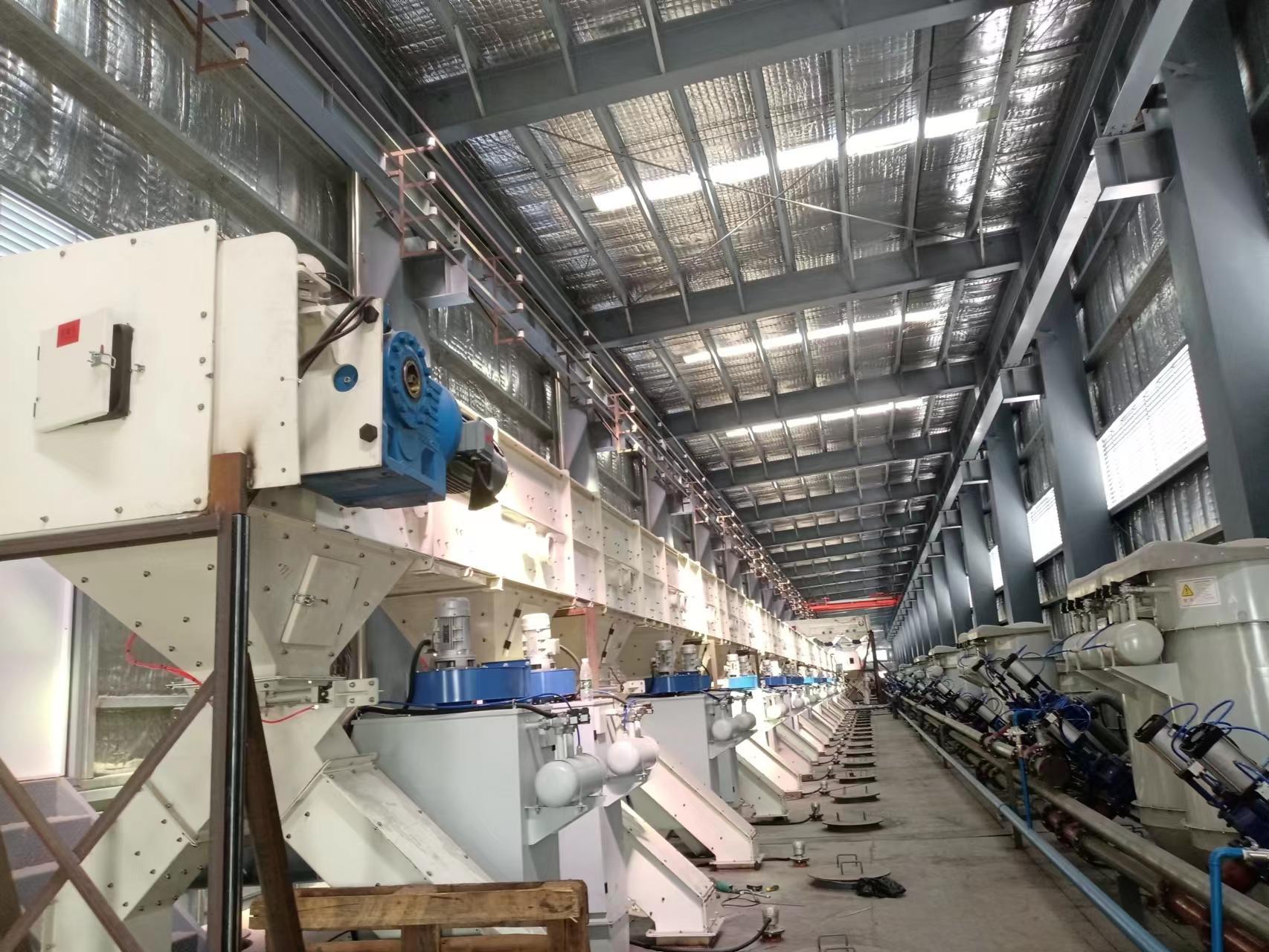
- Number of discharge ports: 2–10 (depending on the workstation)
- Discharge valve: pneumatically controlled
- Control method: PLC control, interlocked with the material level in the downstream weighing hopper, with discharge performed on demand.
III. Notes and Risk Warnings
1. **Strictly prohibit the presence of moisture**: Iron powder oxidizes and generates heat upon contact with water, potentially leading to spontaneous combustion in severe cases. Ensure that the moisture content of the material is below 0.5% prior to conveyance, and maintain a dry environment inside the equipment.
2. **Demagnetization Treatment**: Since iron powder is magnetic, the hopper and housing should be designed to minimize residual magnetism; it is recommended to use austenitic stainless steel (304/316L) or to subject carbon steel to demagnetization treatment.
3. **Nitrogen Protection Continuity**: The nitrogen supply must be stable, and a backup gas source or storage tank shall be provided.
4. **Compressed air blowing is prohibited**: Blowing can stir up dust and create an explosive dust cloud; vacuum cleaning should be used instead.
5.**Regular Cleaning**: After each shift, clean the feed inlet, discharge outlet, and any accumulated powder inside the shell.
For ultrafine iron powder with a bulk density of 1.5–3 g/cm³ and a particle size distribution of >90% passing 400 mesh, Z-type bucket elevators must be engineered with enhanced design in four key areas: structural strength, sealing integrity, anti-bridging measures, and a dual explosion-proof system. Given the high explosion risk associated with metallic iron powders, a three-tier protection strategy—nitrogen purging, flameless pressure relief, and active explosion suppression—must be implemented. Through customized selection and configuration, Z-type bucket elevators can safely, efficiently, and environmentally responsibly handle the vertical conveying of ultrafine iron powder, making them a reliable choice for lithium iron phosphate production and other powder metallurgy applications.
Relevant Cases

What details should be considered when selecting a Z-type bucket elevator?
What adjustments are required during the maintenance and upkeep of a Z-type bucket elevator?
What advantages does a Z-type bucket elevator have over other types of elevators?
Why are Z-type elevators so popular?
Specializing in the manufacture of elevators for over 20 years.
Hengshui Changhong Mining Machinery Co., Ltd. has been specializing in the manufacture of hoists for over 20 years, integrating technological development, production and operation, and technical services into one. Drafting author of Changhong Z-type (vertical spiral bucket) elevator enterprise standards, patent-technologied manufacturer, reputable producer of mining machinery with superior quality and strength.
Contact Info
Contact: Manager Pang
Phone:8613932836877,8613315840327
Phone:0086-318-4869777
Fax:0086-318-4868277
Email:384023722@qq.com
Address: Mada Development Zone, Fucheng County, Hengshui City, Hebei Province